Welcome to visit the official website of Shiningkey automobile electric appliances(shanghai)co.,Ltd.
Electronic Parking Brake (EPB) systems have been widely applied, and the EPB switch, as its core control unit, has replaced the traditional mechanical parking lever and become a standard configuration in modern automobiles. It not only simplifies parking operations but also enhances driving safety and riding comfort through synergy with the vehicle's overall systems. With the intelligent and electrified transformation of automobiles, the technological upgrading of EPB switches has entered a new phase.
Safety and convenience are the core values of the EPB switch. In terms of operation, the button, combined with the Auto Hold function, can realize automatic locking when the vehicle is parked and automatic release when it starts, solving the problem of vehicle slipping on slopes. In terms of safety, after its commands are processed by the ECU, the braking force can be automatically adjusted according to the slope and load; there is a protection mechanism against accidental touch at high speed, and the emergency braking triggered by long pressing can be linked with the ABS, with better performance than the traditional handbrake.
Nowadays, the EPB switch has become a collaborative node for multiple systems. It interacts with the Electronic Stability Program (ESP) and transmission through the CAN bus to realize the linkage control between gears and parking. Its fault self-diagnosis module can monitor the status in real-time and issue a light alarm when an abnormality occurs, making it an important part of the intelligent cockpit information interaction.
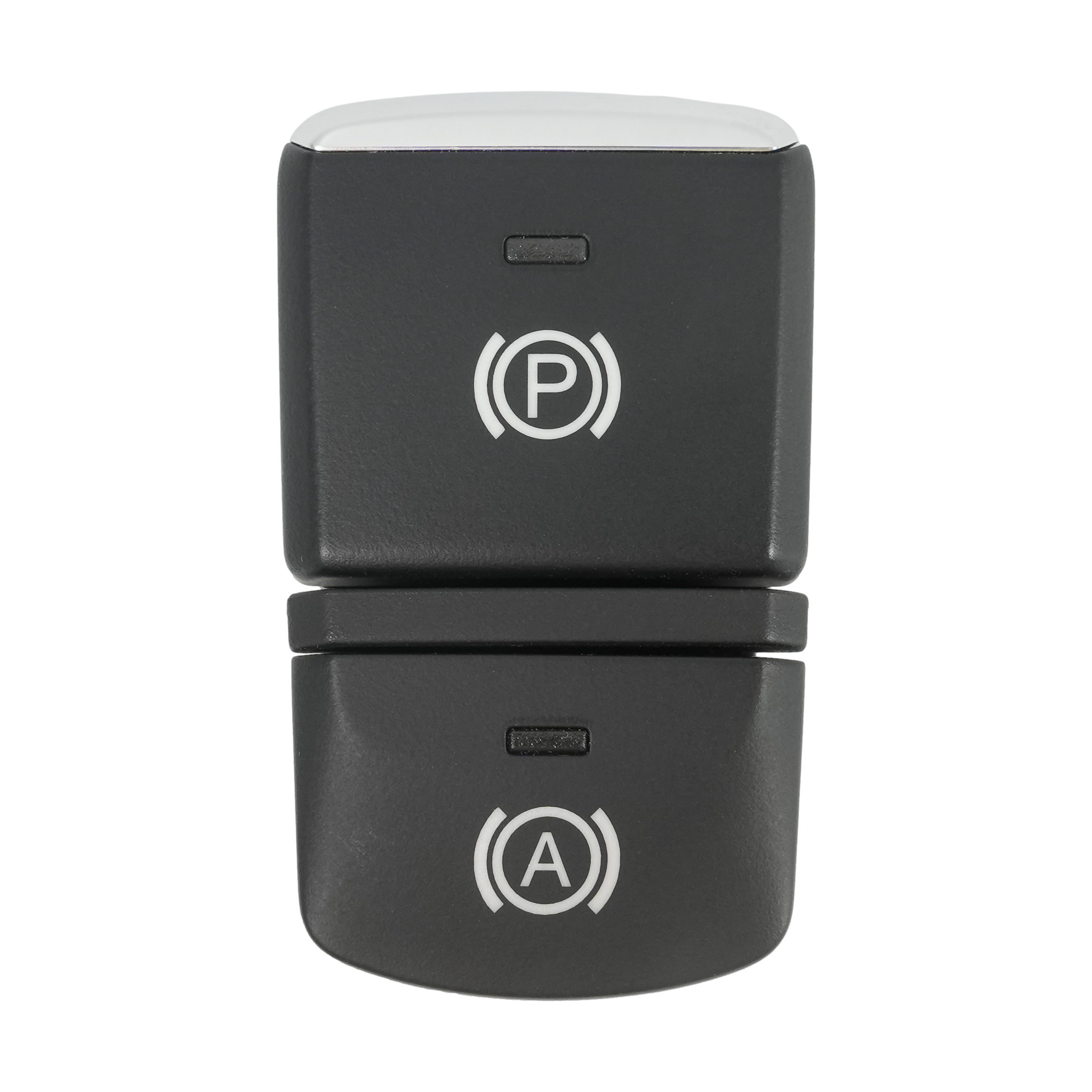
The EPB switch presents three major development trends: first, adapting to the 48V mild hybrid system to achieve low power consumption, reducing energy consumption by more than 50% when parking on the maximum slope; second, deepening functional integration, reducing the weight of wiring harnesses by 25%; third, complying with the ISO 26262 ASIL-B standard, with adaptability to extreme environments ranging from -40℃ to 85℃ and multi-platform compatibility.
Facing market competition, manufacturers need to build core advantages. Technologically, they should keep up with the trend of voltage upgrading, integrate technologies such as eFuse into the switch, and realize multi-channel control through a small 6×6mm package to save space and costs. In terms of safety, they must strictly abide by the ASIL-B standard, strengthen redundant design and adaptability to extreme environments to meet the requirements of automakers.
In terms of services, they should build a modular platform to adapt to different vehicle models, provide customized functions for high-end vehicles and cost-effective versions for economical vehicles, and launch remote upgrade services. At the same time, they should deepen industrial chain collaboration, conduct joint R&D with chip manufacturers, participate in the design of automakers in advance, reduce costs through large-scale production, and promote the application of high-end technologies in mid-to-low-end models to achieve competitive advantages.

Address:No. 635 Jianghe Road, Sijing Town, Songjiang District, Shanghai, China
Telephone:021-57620011
Fax:021-57629089
Mailbox:yxe@skswitch.com
 Pay attention to us