Welcome to visit the official website of Shiningkey automobile electric appliances(shanghai)co.,Ltd.
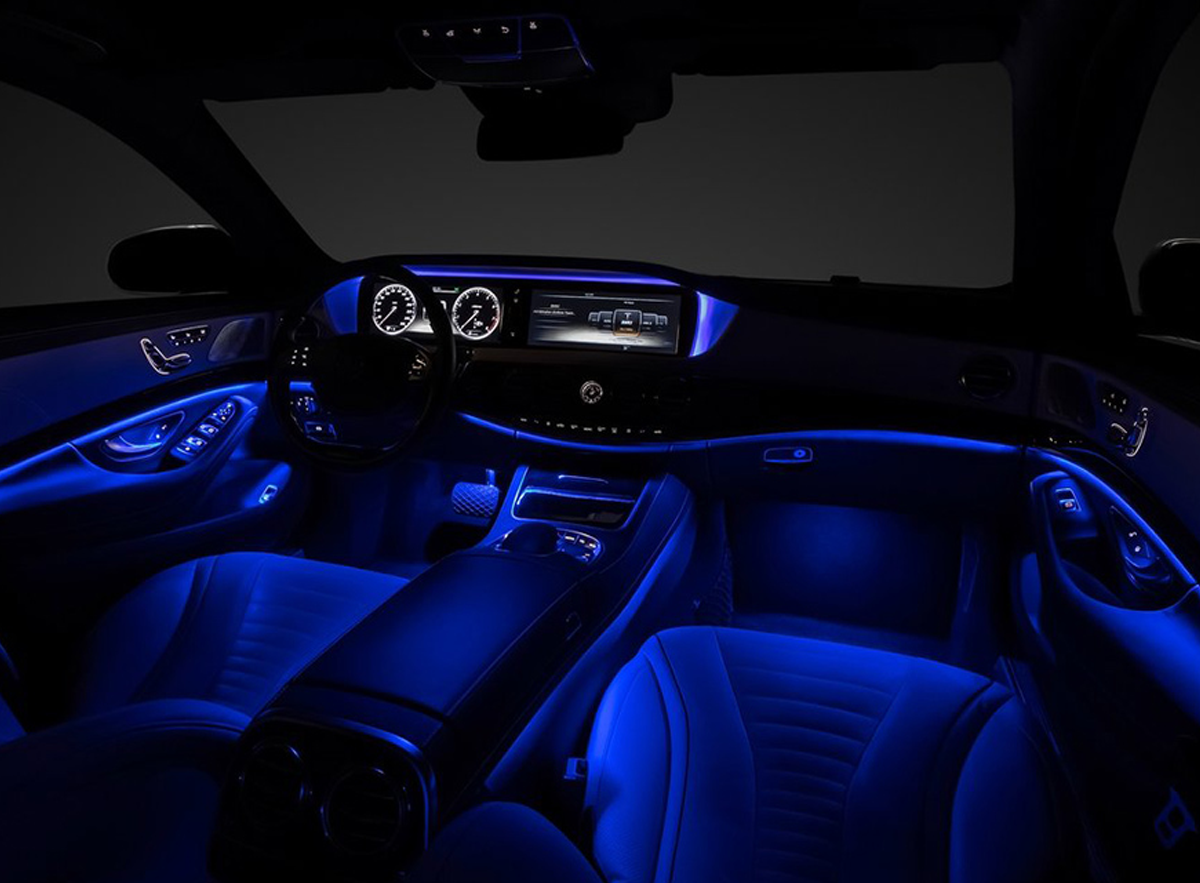
As an auxiliary light for creating atmosphere in automobiles, car ambient lighting has now become a growing focus for major automakers. It is not only a decoration that enhances the in-car atmosphere and reflects personality, but also a key manifestation of brand recognition for major automotive brands. With the in-depth development of the smart cockpit concept, ambient lighting will also move towards intelligence, providing richer expressions for in-car HMI (Human-Machine Interface) design.
In terms of application forms, the design of ambient lighting directly reflects the value of vehicle models. The through-type light strips in the instrument panel and central control area achieve uniform illumination through flexible optical fiber technology; in some high-end models, these light strips can extend across the entire front row, creating a sense of spaciousness. The streamlined light strips on the door panels are arranged along the contour, integrating with interior materials to create multi-layered light and shadow effects. For seat ambient lighting, micro-LEDs are embedded into the stitching using light-transmitting leather technology, becoming a hallmark of high-end models. Additionally, the ambient lighting in details such as footwells and storage spaces not only provides basic illumination but also enhances the sophistication of the cockpit.
Technology selection is crucial for differentiating vehicle positioning. Entry-level models mostly adopt single-color fixed light effects to meet basic needs; mid-range models upgrade to multi-color adjustable lighting, covering key cockpit areas; high-end models are equipped with hundreds of independently controllable LED light sources, which, combined with special optical designs, achieve customized light effects. This technological gradient makes ambient lighting an important tool for widening the positioning gap between vehicle models.
In the future, the development of ambient lighting will advance comprehensively towards intelligence, personalization, and scenario integration. In terms of intelligent interaction, it will connect with sensors and AI algorithms to automatically adjust light effects by monitoring the driver and passenger status—for example, using blue-green light to relieve anxiety and warm yellow light to aid sleep at night. Safety warning functions will also be strengthened: when a vehicle approaches from the side or rear, the corresponding area will flash red lights, which is more intuitive than sound prompts.
Personalized customization will become mainstream. Users can customize light effect themes through mobile apps. Invisible light source technology will enable seamless integration of light and shadow with interior decorations, and even realize personalized signature projections. Technologically, Mini LED and OLED will be widely applied to solve problems such as uneven light guidance and light pollution. Meanwhile, ambient lighting will connect with air conditioning and audio systems to create immersive scenarios, and the linkage of light and shadow inside and outside the vehicle will further expand its application boundaries.
From a lighting decoration to a core component of intelligent interaction, the evolutionary path of ambient lighting epitomizes the people-oriented development of smart cockpits.

Address:No. 635 Jianghe Road, Sijing Town, Songjiang District, Shanghai, China
Telephone:021-57620011
Fax:021-57629089
Mailbox:yxe@skswitch.com
 Pay attention to us